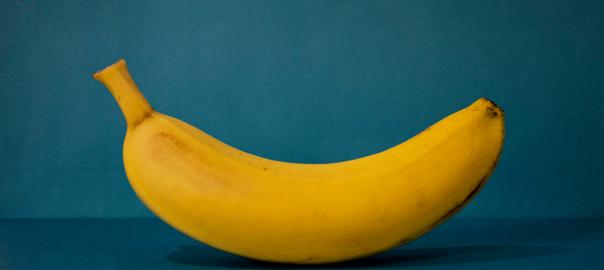
Today’s prompt: A banana becomes a famous musician.
(From page 6 of A Complete History of Produce Section Savants)
Banana “Brown Spot” Coleman
Of the many fabled stories of famous produce, perhaps none is more tragic than that of Banana Coleman. Born Banana Yeshiva Pasternak to a Jewish treelike herbaceous flowering plant in Cuba, young Coleman escaped to Los Angeles during political unrest in the mid-1950s. Coleman had long dreamed of being a famous blues musician. As a Cuban Jewish banana, he’d seen some things. Yet, once he landed in the United States, he soon realized he’d need to change his name to hide his Jewish heritage and assimilate more into the Black culture.
At the time, Coleman was told he could pass for “high yellow,” a term that referred to light-skinned Black people and was considered inoffensive because it was the 1950s in America. Both of these facts pleased Coleman, who assumed his welcome into the Black community was all but clinched. His preference for a highly surreal Klezmer-inspired form of the blues, however, did little to promote this, and he was initially shunned. It wasn’t until the sympathetic blues guitarist Eggplant “No Fingers” Emerson (p. 5, A Complete History of Produce Section Savants) noticed Coleman’s freckles and suggested he add “Brown Spot” to his name to sound like an established blues guy. While logic would dictate that this would not work, it did. In a remarkably short time, Coleman went from performing at bar mitzvahs to blues bars, where he was gaining attention for playing his what some labeled “visionary” and others said “some flat-out off-the-wall jive” style of music. It didn’t take long before he was invited to play at the well-known 5-4 Ballroom in Los Angeles. This esteemed opportunity had never been afforded to a banana before, given that an average of only one in roughly 7,362,003 bananas possess any notable musical talent.
Coleman was noted by critics in music rags as ‘brilliant’, ‘a stunning talent’, and ‘appealing’ by a particularly dull critic from Altadena who believed puns were the mark of genius. Sadly, Coleman’s rapidly rising star would be his ultimate undoing. Not unlike Pomegranate Parsons (p. 3, A Complete History of Produce Section Savants) whose meteoric rise to fame drew the young painter into some rather seedy situations (no pun intended, I assure you), Coleman began to mingle with a questionable crowd who did not always have his best interests at heart. His judgment became increasingly clouded by a lethal combination of fame, jazz cigarettes, and cocaine. One fateful day, he met two enthusiastic Jewish men named Ira Robbins and Burt Baskin. He felt an immediate connection to his heritage that he’d tried so hard to conceal. The brothers-in-law were interested in making Coleman a part of their new business venture. When they mentioned the word ‘split,’ he assumed they were talking about the profits. Against the advice of his manager, he entered into a business venture with them. Just two days later, his body was found by a delighted child at an ice cream parlor table. It was laid out in a shallow bowl, literally split down the middle, sandwiching three scoops of ice cream, and covered with a variety of deliciously sweet sauces.
Now seen as the pre-eminent and only pioneer in Klezmer-inspired blues, Coleman’s legacy will live on for the duration of your reading this article and likely not beyond. And that is the true tragedy.

