Tag Archives: very short stories series

#9 – Number Nine

The MANY men in my family tried to raise me with indifference to gender, teaching me how to change a tire, throw a punch, build a fire, that sort of thing. I think they may have overshot though. No, I didn’t blossom into adulthood as a pyromaniacal auto mechanic with a penchant for getting into fights. First off because I’m not the type to blossom. But also, I am cursed with what some folks call “dainty wrists.” I do, however, have a closet full of men’s blue mechanics’ shirts complete with an embroidered name tag that says Sam – which happens to be my name. And these shirts comprise the majority of my wardrobe. 

I mean, I’m not a complete pine stump barbarian when it comes to fashion. I do accessorize them with various items as they fit my mood and/or weather. Plaid shorts or skirts, fish-net stockings, army boots, leather jackets, maybe a big blocky cardigan. It’s not a look you find in glossy magazines and I get glances from women as they pass me by. Especially young women who are my age – these denizens of fashion who regard the current trend of paint-splattered shirts, torn jeans, and all things neon as haute couture. Leg warmers? Come on. And yet I’m considered a fashion faux pas.

“You’re a pretty girl,” my mom always says in regards to my wardrobe. “I don’t know why you think you have to try to prove a point.”

“I’m not trying to prove a point,” I always respond, although I suspect she’s right. I probably am trying to prove a point. I just don’t know what it is yet. I’m 22 though. I reckon I have some time to figure it out. 

“You could go to college and start over,” she also always says, leaning in closer and staring into my eyes, like she’s certain college will solve all my wardrobe malfunctions. 

“Start over?” I always ask. “Start over what?” I’m not trying to be obtuse. I really don’t understand her line of reasoning.

She never gives me an answer though. She simply sighs and up into the air go her big burly hands – the kind that could effectively build fires, change tires, and throw punches – and which she did not pass down to me. Then she walks out of the room. 

It’s not a productive conversation, to say the least. But I guess productivity has never been our thing – my mom’s and mine. She has a much more productive relationship with her dog, Stanley. I suppose he’s easier to understand. Even though they don’t speak the same language. Though I’m not sure we do either.

The shirts – the ones I wear every day – belonged to my dad’s much younger brother, Sam. As a peacenik and a conscientious objector who managed to stave off shipment to Vietnam, he asked that I never refer to him as Uncle Sam. Fair enough. 

Throughout my childhood and adolescence, Sam was hands down my favorite family member. He took me on excursions from our small rural Illinois town to Chicago several times over those years. 

“Ya gotta see the bigger picture, Samantha,” he said the first time we went. I didn’t know what he meant, but Chicago was bigger than anything I’d seen up to that point. The biggest thing I’d seen in our sleepy town was the 1976 Bicentennial parade that went down Main Street when I was eleven – half my age now. Some of the girls in my school rode their bikes in that parade. I never understood girls. Even then. I’d preferred Matchbox cars to Barbies; insects to jewelry; mud to perfume. And with only two older brothers, I felt distinctly out of touch with my fellow uterus-bearers. I remember being taken that parade day though by the shiny red and blue streamers sparkling in the sunlight and the white ribbons in my classmates’ sun-kissed blonde hair and feeling a tinge of jealousy that I didn’t understand. 

“The small-minded folks with their narrow scope, they’ll eat you alive,” Sam said that day. “Chew you up and spit you out just as soon as they’d rat out your own mother for hanging the wash wrong.” I remember wondering what that meant, but assumed it was some brand of brilliance that required decoding I wasn’t yet sophisticated enough to possess. 

That may have been what made Sam my favorite. I sensed that he was different; that he also struggled with conventionality. He’d worked for years as a steady and reliable mechanic at Lloyd’s Body Shop. Then one day, he moved into a trailer outside of town and started taking on work as a shade tree mechanic. When I was fifteen, he began to disappear for weeks at a time – wandering off to California, northern Canada, and eventually Thailand. I was envious. I suppose at the time he thought that traveling to some far-flung place seemed like a good idea. I had no idea he was trying to get away from himself. 

When I was 17, he pulled me aside at our family’s annual July 4th reunion and began ranting about the inhumanity of man toward man, along with some other garden-variety rhetoric that had become all too common for him. “Ya know,” he paused. “Lennon said that nine is the highest number in the universe.” He smiled. 

“Yeah?” I said, unsure of the Lennon to whom he was referring. I wanted so much to understand his world and still thought that when I got older and grew up, I would get it. 

Sam nodded and a smile crossed his face. “Yeah. Cuz after that, Samantha,” he whispered, his eyes off in some dreamy place, “you go back to one.” He held up one finger, then twirled it a few times and tapped the tip of my nose. He got up and walked away. The Lennon to whom he was referring was, of course, John and not Vladimir, which is spelled differently anyhow.

I didn’t know it at the time, but that would be my last conversation with Sam. He disappeared a week later and his body was found two weeks after that. The coroner deemed it a suicide. It wasn’t until weeks later when leafing through one of his heavily illustrated journals that I learned about the voices. 

To this day, I wonder what the voices sounded like for Sam. If they were men or women. Or maybe both. I wonder if any of them sounded like me. Maybe that’s a weird thing to wonder. But my middle brother hears voices now. He tells people they sometimes sound like Sam, but won’t reveal whether it’s our uncle or me. 

And no matter how old or grown up I get, I’m not sure I’ll ever know what to make of that. 

*(modified excerpts from Crying in the H. Mart by Michelle Zauner)
#8 – Negative Hands and Blank Slates

By the time I awaken, the notifications have already started rolling in. Though it’s more accurate to say that they awakened me. Each jingling tone from my phone feigning flattery; inveigling into my unconscious until it too is forced to awaken. “Your input is crucial,” they say. Or “without you, I cannot form an opinion.” These are, of course, the interpretations from my unconscious who cannot actually read and whose intellectual meanderings are consistently either suspect or spot-on. 

Today, it is the former. 

I know my opinions don’t matter. I’m nothing more than a lowly assistant. I have no chops. No street cred. Not yet, at least. The notifications remind me of such. Because what they really say is REMINDER! BE AT THE SITE NO LATER THAN 6AM and YOU WILL BE RESPONSIBLE FOR THE INSTRUMENTS AND TAKING OF COPIOUS NOTES, YOU WORM. Okay, they don’t call me a worm. The subtext is there though. 

I realize I have to pay my dues. We all do. It’s part of the deal. And I’m aware that I won’t always have to idly stand by and pretend to care when one of my least favorite post-docs waxes poetic about something like how a sequoia can withstand a thousand years of earthquakes, fires, and wind, to finally just one day fall. He states these observations in such a way that they come across as less a lamentation and more a sociopathic rant.

“Yeah, it’s a real shame,” I typically respond shaking my head and, in the case of tree at least, thinking that at 1000 years, the tree had a good run. My grandmother is not even a tenth that age and isn’t faring nearly as well. 

My phone chimes again. It’s mocking me. I’m sure of it.

REMEMBER TO BRING THE THERMOS

I roll my eyes. As if I’d forget the thermos. I know full well that the scientists can’t make any sweeping discoveries without coffee and that what the message is actually conveying is to remember to make coffee. I sigh. Again, paying my dues. 

I didn’t sleep well last night. It was all the excitement, I suppose, of being party to some of yesterday’s discoveries. Even so, I’ve never slept well the first night in an unfamiliar place. My sensory organs thrive on routine and are priggish about change. Particularly at night. My ears find solace in the muffled sounds of cars, people’s voices, and music fading in and out as the evening slowly stretches its long bony fingers across the city. Meanwhile, my nose is accustomed to the scent of exhaust from the aforementioned cars, the twinge of mustiness from my couch’s throw pillow, and the red and orange smells of warm Indian spices from my neighbor’s apartment by 7pm every day. (4:30 on those dusky winter afternoons). 

Last night, however, my ears were accosted by some rather ghostlike and inchoate owl calls as I pressed a stiff, white, science lab-issued pillow over my nose in an attempt to conceal the odor of wild rosemary and thyme growing just outside the tent. It wasn’t that it was a bad scent. Just strong. And unfamiliar. And it was making me hungry, if I’m honest. 

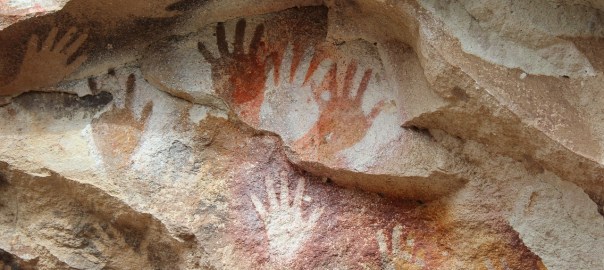
Then there were the negative hands. I hadn’t expected to be so taken by those ancient prints on the cave walls that had been there for thousands and thousands of years. There were so many hands in so many different sizes. There were large handprints stamped steadfastly at the entrance of the cave as if to say either ‘welcome’ or ‘stop.’ (The handprint was as unreadable as my unconscious.) Then there were somewhat smaller hands going along the side walls. Were they placed in celebration? In bondage? Did it matter?

What stayed with me the most were the tiny handprints on the ceiling of the cave. Clearly, an adult had hoisted a small child high up onto his or her shoulders, then slowly spit a warm mixture of water and pigment over the little hands to create those images. Many of my colleagues were atwitter by the notion that there is probably DNA in that ancient spit that begs analysis. I, on the other hand, was curious about how the child might have felt about that ancient spray paint spit on his or her hand. And would he or she have any notion that these prints would last well into antiquity? (The answer is: of course not.)

I sit up in my cot rather swiftly and three magpies picking at something outside my tent take immediate flight. I think of my mother and her love for magpies. She adored how they are drawn to shiny and sparkly things. My mother in her beautiful cashmere dresses; rhinestone-rimmed sunglasses embedded in her auburn hair. My mother who encouraged me to go into something – anything – more glamorous than science. Fashion perhaps. Even interior design would have sufficed. 

Glancing at the sky, I see the sun is on the horizon. It’s a brand new day. A chance to start over. In theory, at least. And there will be no A-line dresses or recessed lighting plans for me to consider. I’ll probably have mud on my shoes by 9am. Hell, I’ll probably have mud IN my shoes by 9am. And I wonder how feasible it is to strive for a blank slate each day. To start from zero. Tabula rasa. Because, yeah. Yearning for a blank slate crosses the ideological spectrum. But the truth is, sooner or later, even the newest places will face the same old problems. 

I stretch and yawn as I roll off my cot. 

Time to start making the coffee. 

*(modified excerpts from The Atlantic)    

#6 – Welcome to Armantrout!

Here in Armantrout, we take great pride in our town. Everyone you pass on the street will greet you with warmth, friendliness, and wide-eyed smiles that occasionally border on questionable mental illness. Plus, you’ll be gobsmacked by the beauty of our homes and businesses that bear a playful mix of Cisterian, Anthropophagy, and Herodian architectural styles – the latter of which is an homage to the Roman customer lord of Judea. Obviously.

A visit to Armantrout places you among an exclusive class of uniquely-minded travelers. In fact, our town has been likened to Florida by travel writers from the greater Eufaula, Alabama area as well as around the globe. As a case in point, Lester Leafblower from the esteemed travel journal Why Go There? eloquently stated, “Armantrout is not a place that makes anything and it’s not really a place that does anything – other than bringing in more people.” Just like Florida.

Also like Florida, Armantrout is a site to behold at any time of the day and in every season. The most popular time to visit, however, is during our annual Straw Festival in mid-March. Aquatic sea turtles aside, we’re proud to celebrate what we deem the world’s greatest invention – developed in 1864 by Armantrout’s own Benjamin Bendy. Don’t ask for ‘no straw’ with your beverage here! If possible, the best time to arrive in Armantrout is in the late evening when you can drive Bendy Boulevard along Loch Straw and observe the wind-torn whitecaps whispering and roiling while a vicious, grudge-holding moon creeps slowly across the sky. It’s all very poetic. You might even catch a glimpse of our own legendary Loch Straw monster. There are those who believe this is nothing more than a floating barge of plastic bottles given Armantrout’s “short-sighted and abysmal recycling program” (Leafblower, Lester, Why Go There?, issue #29, p. 63). But any Armantroutisian will tell you differently. So you should believe them.

While downtown Armantrout boasts major attractions such as the world-renowned Cow Museum and the illustrious Just Umbrellas! shop, it’s the now-defunct carnival site just beyond the city limits that seems to draw the most visitors. Or maybe ‘squatters who are untroubled by the cracks in the wall that seep cold air and centuries-old secrets that would make anyone shudder’ is a more accurate description.

Whatever the case, the majestic Bendy Mansion is a perfect specimen of the Anthropophagy (translated as human flesh consumption) architectural style. Working from a rather provocative belief system in 1800s Brazil that promoted consuming pilgrim oppressors to accomplish self-governance, the mansion is now epitomized by mechanical primitivism with striking dream-like symbolism. What’s more, if you’re a ghost hunter, you’ll be delighted to know that the mansion is haunted by the soul of the carnival’s resident World’s Smallest Man who had just laid bare his body and the real truth of its deformity before being trampled by a herd of cows.

So come and visit our little slice of paradise.

If you favor the quietude of isolation – away from the quick-witted quips and subsequent quicksand of human interaction that can so swiftly and skillfully swallow you whole, then Armantrout is just the place for you. Contact Belinda Bendy-Straw at the visitor’s bureau today to add Armantrout to your bucket list!