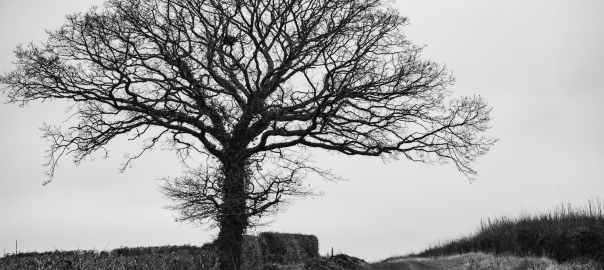
#18 – The Sentinel Tree

“The secret to keeping plants alive is striking that perfect balance between care and neglect,” Fiona remembered her father telling her as he tended the flower and vegetable garden that flourished behind their old house. Throughout her childhood, she’d marveled at that verdant patch that blotted the otherwise vast moonscape of south-central Wyoming. Beyond that garden, nothing else seemed to thrive. Nothing, that is, except for the single American Linden tree a quarter mile beyond the garden and under which she now sat.

“That’s what’s known as a sentinel tree,” her father had said. “It’s a guide. A landmark, see? You’ll always know where your home is when you see it.” She’d looked up at him, observing the auburn streaks in his sheen brown hair, the reddening of his freckled skin, and a degree of seriousness behind his blue eyes. Eventually, her eyes grew tired from looking up at him and into the sun. “The Linden symbolizes peace,” he continued. “And the bees love the flowers. It’s not exactly native to these parts where the cottonwoods are happiest,” he’d said pensively. “But this one is a survivor. It was here long before you and me and will be here long after we go. So long as someone tends to it.”

Those words stuck with her. As did the notion that success in keeping plants, or anything really, alive was striking the perfect balance between care and neglect. It was a balance she wasn’t certain she could attain. Especially the neglect component. As a child, Fiona’s mother had coddled her. It seemed better than neglecting or hurting her. But her mother had inadvertently taught Fiona that life was supposed to be easy and comfortable and when it wasn’t (as was increasingly the case now) it was somehow personal. That she had been cosmically wronged. 

Her mother would not tolerate Fiona facing any sort of adversity. This despite the fact that such experiences were essential for Fiona to acquire some very needed tools. So Fiona’s toolbox, in that area at least, had for a long time been as empty as the promises from her neighbor that he’d fix the loose hand railing on the front stairs of the old house next time he was out her way. 

Meanwhile, if her father saw the unintentional damage her mother was causing, he did not come to Fiona’s rescue. While they shared a deep love for the garden plants and that sole Linden tree, he was otherwise emotionally guarded. Even withholding. But not in a steely resting Clint Eastwood as Dirty Harry face sort of way. It was far more subtle, covert, and therefore insidious. Because she simply didn’t see it. 

The thing is, her father knew how to smile and laugh. He was good at being with people. While he may not have sustained long relationships, he was the master of first impressions. And he had a knack for making folks laugh. She recalled the spring when she was nine and her father and mother took her to the bakery in Cheyenne. Gobsmacked by the huge display of delights, she’d stared at the rows of cakes and cookies for what seemed like hours. At last, she tapped the glass in front of a pink cupcake. “Don’t tap the glass, Fee,” her father scolded, then winked. “It frightens the cupcakes.” Though Fiona’s mother rolled her eyes, the woman behind the counter giggled. And Fiona broke into a full belly laugh at the idea that she could frighten a cupcake. 

So it perplexed her and upset her in the following years when the phone calls started. She’d answer the ring and different voices would ask for the village idiot before laughing and hanging up. Surely, she thought, these were wrong numbers. They couldn’t have been talking about her dad; the man who knew how to conjure bright red tomatoes, brilliant orange sunflowers, and deep green zucchini from an otherwise dead patch of earth. To her, he was a magician.

Sitting under the Linden tree now she thought of her father who’d long since abandoned her, her dementia-ridden mother for whom she now cared, and the mighty tree to move to Arizona. There he could dodge the harsh Wyoming winters while the political climate of the country grew colder and more bitter by the minute. She started to receive the occasional attacking text from him in the middle of the night accusing her of being an unpatriotic Marxist, among other things, because of her left-of-middle viewpoints. She didn’t know what to make of them at first. Given that she understood him to be kind, compassionate, and funny, she wondered if he was having brain issues. Here she was five years later and sitting with the truth of it all. She shook her head hard as though trying to shake off this reality. How ignorant she’d been to believe her father would be as repulsed by the misogynistic hateful narcissistic dominating the news as she’d been. He was not. 

Pressing deeper against the bark of the tree, she noticed it had developed an increasing number of ridges and cracks as it aged. She could relate. Pulling a pad of paper and pencil from her bag, she set to doing what she came out there to do. She began composing a letter.

She reread the letter three times and sighed. These days, she felt both deeply lost and yet on the precipice of figuring something out. And she was old enough to know that maybe it was something she needed to but didn’t necessarily want to face.

Looking up into the canopy of the tree, smelling the fragrant flowers and smiling at its clusters of small hard fruits and lovely heart-shaped leaves, she felt a deep affection for the tree that she hadn’t in over a decade. Her father was not the village idiot. But neither was he a magician. 

Knowing it would make no difference, she decided against sending the letter. Instead, she sighed, crumpled the letter, and shoved it deep in her bag – certain that the sentinel tree would never again mark the way home for the man she still knew as dad.

*(Heavily modified excerpts from The Winter People by Jennifer McMahon)

#17 – Motorcycle Jesus and the Collectors

It was an impossibly sunny morning as Frank the Tank meandered down the curving street that created the periphery of the town’s center. The old garbage truck seemed to be sniffing out treasures – crumbled papers, nail clippings, discarded styrofoam containers sticky with rancid grease, things of that nature. 

“Sure is a nice one out there today,” said Horace, one of the three sanitation workers assigned to Frank. “Beats the hell outta them days in January when we was freezin’ our asses off.” 

“Hmmmm.” Sam, the driver, nodded in what one could assume was agreement.

“That’s for damn sure,” said Clive, the third worker, who stared out the window and yawned. He tied his bandana tighter around his head and smacked his lips – a habit he’d picked up in juvie. 

Horace held up his latest whittling project in the sunlight and admired his work; pleased that such a satisfying craft was making a comeback. “Whadya think?” he asked, shoving it into Clive’s face.

From what Clive could see at that extreme close-up position, it appeared to be a motorcycle whose rider was a man with long flowing hair. Jesus perhaps. But with a helmet. 

“Ya like it?” Horace asked. His voice took on a subtle childlike need for approval. 

“I’d like a lot more if you’d get it out of my face,” Clive responded, swatting at the wooden piece.

“That’s what she said,” laughed Horace; the snappy comeback ever elusive to him. He pulled back the wooden piece and stared at it intently.

Although Horace lacked eloquence, he wasn’t stupid. He had what Clive and Sam called automotive intelligence. His happy place was on a creeper staring at the underbelly of his car. He took his explanations of the workings of an automobile to passionate new heights. It was pure science for him. And like most science, it was pretty accurate, sometimes boring, and always very sure of itself. 

As Sam gingerly turned the steering wheel to direct Frank up to the next load of garbage, the truck’s brakes squeaked in protest and it farted out a puff of smoke. Aging for a truck was no more dignified than it was for a human. Maybe even less so, thought Horace, having seen his fair share of old trucks and their innards. He did not consider himself old though, in spite of the fact that the fingers and thumb of his right hand were smarting more than they used to after just two days of whittling. He gave them a gentle massage.

“Sounds like Frank’s needing a break,” Sam grumbled. Horace and Clive knew that what that really meant was that Sam needed a break. Set to retire that year, they both wondered what was next for Sam. Especially Clive. They wouldn’t go so far as to say they worried. Not out loud, at least. It’s just that Sam had been a collector for nearly fifty years. By comparison, Horace and Clive had only logged twelve and eight years, respectively. This was long enough for Horace to see his youngish kids grow into youngish adults, and for Clive to see the light at the end of the tunnel in terms of finally getting his psychology degree. 

Sam pulled himself out of Frank’s creaky cab and meandered to the large magnolia tree that grew just beyond the city hall. With some effort, he settled at the picnic table nearest the tree. Clive sat across from him while Horace opted for sitting on the ground at the base of the tree. It was in explosive bloom and overlooked swaths of land drenched in a rainbow of colors created by the kids in the middle school’s 4-H Club who’d planted a spectacular path of petunias, impatiens, snapdragons, and marigolds that wound in and around the government buildings. Horace had been a part of that when he was in middle school. And Sam’s kids had for several summers participated in the same event. He’d always assumed his grandbabies would too – had his kids not picked up and moved to Atlanta, Baltimore, and Detroit. Still, he didn’t want to complain. That’s just the way it goes, was his motto and he was well known for saying it with a smile and a passive shrug. If he were being honest though, it sucked that that’s how it went with his kids.  

Sam took a deep sigh and poured lemonade from the thermos that he brought with him every day. His wife Thelma had gotten him the thermos the week before he started collecting and he’d never once lost it – a point in which he took great pride. Its red paint had long since worn off in the places where he held the well-nicked, well-dented, and much-loved vessel.

Horace started whistling. “Look at them birds over there,” he said, pointing to a cluster of cardinals, grackles, and sparrows that had perched on a weathered old fence that bordered a stand of lilac trees. “It’s kinda like they’s got together to share in a bit of gossip,” he said with a mischievous smile that showed even through his thick red beard. 

Clive turned his head and studied Horace as a psychological specimen for a moment – as he was wont to do. Horace generally didn’t notice when he did this. Today was no different. 

Horace leaned his back against the tree and pulled out his whittling project to give it some touch-ups. “It’s like them birds is saying, ‘Hey there now! Who among ya couldn’t use a wee new friend?’” he observed, taking some fine-grain sandpaper to motorcycle Jesus’s face before turning to Clive. “Ya know what I mean, Clive?” 

Clive cocked a brow and nodded at Horace. “Oh yeah, sure.” He then turned to Sam and shook his head. 

Sam released a low almost clandestine laugh and he noticed that something in the moment felt balanced – that there was a rightness to the world. He looked up at the wide blue sky and closed his eyes to the warm sun. At that same moment, Frank let out a long hiss, followed by a longer sigh and a clunk that Sam felt almost certain heralded an end.

“Oh boy,” said Horace as he got up and walked over to Frank to investigate. “Don’t like the sound of that ONE BIT. Frank? You alright?” he called out to the weary old truck. 

Clive and Sam sat at the table. Clive cleared his throat and looked at Sam. “Ya know, I, uh,” he stammered, “I’m gonna miss you, Sam.”

Silence came over them for a moment.

“And I’ve never had a chance to thank you for everything,” Clive continued, then shook his head. “No, that’s not true. I’ve had plenty of chances but just didn’t know how to say the words, ya know,” he rubbed his face with his hands in slow circles. “I mean, you helped me clean up. You got me this job. You put me on the right path…”

You put you on the right path,” Sam corrected him. 

Clive smacked his lips again and squinted in the sunlight. “Maybe. But I wouldn’t be here today without you. And I know that to be the absolute truth. You’re more of a father to me than my own will ever be…”

“Well, I’ll be damned,” Horace called out. “Seems Frank’s up and left us for truck heaven.” 

Sam nodded to Clive and patted him on the arm. “No thanks are necessary,” he said. “But you’re welcome.” 

Clive smiled.

Sam paused and thought about how he hadn’t just spent fifty years collecting refuse so much as stories. Both the stories that were real and the ones he told himself.

“Who’d’ve guessed?” said Horace who’d made his way back to Sam and Clive, shaking his head. “Traitor truck. I was thinkin’ he’d take ya to retirement at least, Sam.” 

“Yeah,” Clive said. “I thought so too.”

Sam looked at Frank, then back at his fellow collectors. He smiled and shrugged. “Guess that’s just the way it goes.”

*(modified excerpts from the Signals catalogue)

#16 – Yoga As Taught By My Neighbor’s Asshole Cat

Welcome. Namaste. Or should I say, pawmaste? No, I shouldn’t. Because that’s stupid. And I’ve already established I’m not some idiotic pandering mammal like a lemming. Or a dog.

Anyhow, please center yourself on your mat and we’ll begin with our breath. Take a deep inhale and imagine you’re drawing in something you want, such as world peace, deep serenity, or tuna. On the exhale, let go of what you no longer need. Might I suggest that ridiculous blue sweater you wore yesterday? I think it’s time. Continue with this deep breathing until you feel calm, relaxed, and willing to have your belly rubbed. But only briefly. Because anything more than a couple of seconds warrants a ruthless blood-drawing attack. 

Now on the next inhale, stretch your arms up toward the ceiling. Stretch your fingers wide, right down to the dew claw. Keep your arms lifted and come to standing from this seated position. Don’t ask me how. Figure it out. Move to the nearest door jamb and/or long panel curtain and on the exhale, bring your arms down, slowly and methodically dragging your nails along the wood or fabric. Repeat this as many times as needed to ensure irreparable damage. Don’t forget to focus on your breath. Obviously. 

Return to the mat and come into a downward-facing dog. Downward-facing, you see, because all dogs are hell-bound. And the ancient yogis knew this. So don’t question it. From this position, take a deep inhale and extend your right leg high into the air. On the exhale, move your head toward your genitals and give them a lick. This is simply good hygiene. Repeat on the other side. If you’re unable to achieve the tongue to genital bind, you can use a strap or that string of rainbow-colored felt balls I recently tore down from above the crying baby’s crib. I’m willing to share because I’m a giver.

From your hell-bound dog position, you can hop, step, or jump three feet straight up into the air to the top of your mat. You’ll be in a standing forward fold. Roll up from here and come to standing on two feet – painfully inefficient as this is. It’s no wonder so many of you humans have body issues. Intelligent design, my ass. Fortunately, you’ve come to yoga and I am here to fix you. Because, once again, I’m a giver. Now, let’s work on some balance. Tree pose.

Standing on your right foot, bring your left foot to the inseam of your right leg and open your left knee out to the side. Float your arms up once again, admiring your previous path of destruction, and take some deep breaths. There really is no goal here. The challenge is to stay here long enough to feel that deep connection with the earth and for me to cover you with carpet and wrap twine around your standing leg so I may sharpen my claws. Don’t worry if it doesn’t happen on the first side. There’s always another leg. Sadly, I remind you once again that you only have two.

We will make our way out of tree pose and slowly roll back down into a forward fold while observing the floating reflected light forms running up and down the walls from the prism hanging in the window that I haven’t managed to pull down and break yet. I do have a plan though. Now, move every ounce of your attention to the floating light forms and try to catch them. Go ahead. I dare you. See how much you like it. They’re real fuckers. 

On the topic of fuckers, we’re going to go into pigeon pose. Step back from your standing forward fold and come down to table pose. Lift your right leg, but avoid the temptation to scratch the back of your ear with your toenails. Instead, stretch it back and move it about as though you’re either painting a beautiful rainbow behind you or scattering copious amounts of cat litter in the style of Jackson Pollock. Either way, you’re expressing yourself artistically – which is very different from expressing yourself glandularly. Anyhow, you’ll then slide your right knee forward to emulate a mangled pigeon whose innards were recently torn out, consumed, and then puked up onto one very lucky human’s bed. Embrace the simple-mindedness of the pigeon, yet don’t embrace it so much that you poop on the Buddha statue in the corner. I did that last week and it’s not a mistake I’ll be making again in this life. Fortunately, I have eight others.  

Take a deep breath now to release from pigeon pose and transition onto your back. Ease back and relax as I offer various adjustments including a gentle tuck of your shoulders, ensuring your head is properly aligned, and ‘making biscuits’ on your chest while gnawing on your chin. We are preparing for our final pose, sivasana. This means corpse pose and it’s not meant to sound morose. Rather, it signifies the death of the physical practice as you prepare to move into your day. You may want to cover your eyes with a pillow though, as I’ve been told I’m a very literal sort. And if I see you as a corpse, I may just eat your eyes. 

You’ve been warned. 

Peace. Namaste.