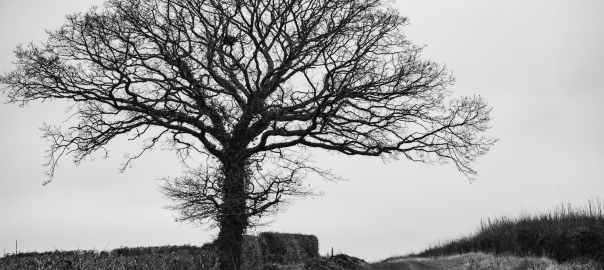
“The secret to keeping plants alive is striking that perfect balance between care and neglect,” Fiona remembered her father telling her as he tended the flower and vegetable garden that flourished behind their old house. Throughout her childhood, she’d marveled at that verdant patch that blotted the otherwise vast moonscape of south-central Wyoming. Beyond that garden, nothing else seemed to thrive. Nothing, that is, except for the single American Linden tree a quarter mile beyond the garden and under which she now sat.
“That’s what’s known as a sentinel tree,” her father had said. “It’s a guide. A landmark, see? You’ll always know where your home is when you see it.” She’d looked up at him, observing the auburn streaks in his sheen brown hair, the reddening of his freckled skin, and a degree of seriousness behind his blue eyes. Eventually, her eyes grew tired from looking up at him and into the sun. “The Linden symbolizes peace,” he continued. “And the bees love the flowers. It’s not exactly native to these parts where the cottonwoods are happiest,” he’d said pensively. “But this one is a survivor. It was here long before you and me and will be here long after we go. So long as someone tends to it.”
Those words stuck with her. As did the notion that success in keeping plants, or anything really, alive was striking the perfect balance between care and neglect. It was a balance she wasn’t certain she could attain. Especially the neglect component. As a child, Fiona’s mother had coddled her. It seemed better than neglecting or hurting her. But her mother had inadvertently taught Fiona that life was supposed to be easy and comfortable and when it wasn’t (as was increasingly the case now) it was somehow personal. That she had been cosmically wronged.
Her mother would not tolerate Fiona facing any sort of adversity. This despite the fact that such experiences were essential for Fiona to acquire some very needed tools. So Fiona’s toolbox, in that area at least, had for a long time been as empty as the promises from her neighbor that he’d fix the loose hand railing on the front stairs of the old house next time he was out her way.
Meanwhile, if her father saw the unintentional damage her mother was causing, he did not come to Fiona’s rescue. While they shared a deep love for the garden plants and that sole Linden tree, he was otherwise emotionally guarded. Even withholding. But not in a steely resting Clint Eastwood as Dirty Harry face sort of way. It was far more subtle, covert, and therefore insidious. Because she simply didn’t see it.
The thing is, her father knew how to smile and laugh. He was good at being with people. While he may not have sustained long relationships, he was the master of first impressions. And he had a knack for making folks laugh. She recalled the spring when she was nine and her father and mother took her to the bakery in Cheyenne. Gobsmacked by the huge display of delights, she’d stared at the rows of cakes and cookies for what seemed like hours. At last, she tapped the glass in front of a pink cupcake. “Don’t tap the glass, Fee,” her father scolded, then winked. “It frightens the cupcakes.” Though Fiona’s mother rolled her eyes, the woman behind the counter giggled. And Fiona broke into a full belly laugh at the idea that she could frighten a cupcake.
So it perplexed her and upset her in the following years when the phone calls started. She’d answer the ring and different voices would ask for the village idiot before laughing and hanging up. Surely, she thought, these were wrong numbers. They couldn’t have been talking about her dad; the man who knew how to conjure bright red tomatoes, brilliant orange sunflowers, and deep green zucchini from an otherwise dead patch of earth. To her, he was a magician.
Sitting under the Linden tree now she thought of her father who’d long since abandoned her, her dementia-ridden mother for whom she now cared, and the mighty tree to move to Arizona. There he could dodge the harsh Wyoming winters while the political climate of the country grew colder and more bitter by the minute. She started to receive the occasional attacking text from him in the middle of the night accusing her of being an unpatriotic Marxist, among other things, because of her left-of-middle viewpoints. She didn’t know what to make of them at first. Given that she understood him to be kind, compassionate, and funny, she wondered if he was having brain issues. Here she was five years later and sitting with the truth of it all. She shook her head hard as though trying to shake off this reality. How ignorant she’d been to believe her father would be as repulsed by the misogynistic hateful narcissistic dominating the news as she’d been. He was not.
Pressing deeper against the bark of the tree, she noticed it had developed an increasing number of ridges and cracks as it aged. She could relate. Pulling a pad of paper and pencil from her bag, she set to doing what she came out there to do. She began composing a letter.
Dear Dad,
As I’ve gotten older, I recognize how comforting it seems to cling to old and outdated ideas. But I also recognize that pushing back against progress and lamenting better days hurts me far more than embracing change and seeing what I can learn. Is it always good? Of course not. But what is? (Don’t answer that.)
I’m not writing this to try to convince you of anything or change your mind. I do want you to know, however, the negative consequences that come with the attacking messages. And not just how they affect me, but you as well. Here’s the truth: you have a strong and resilient daughter who loves and cares for others and who isn’t afraid to speak her mind. She’s kind, generous, considerate of others, and deeply contemplative. By most accounts, she would appear to be the product of proud parents. (These are, incidentally, all values I’d relish in my own children if I’d had any.) And yet, her father – confounded by some wholly unexplored threat of lack and limitation – repeatedly rattles off what he deems as her shortcomings, care of the myopic media sources that routinely (mis)inform him.
I can’t relieve you of the decades of unchecked anger and frustration you’re experiencing and now feel justified in unloading on those whom you love. If I could, I would release you from that particular brand of misery. But if I’m being brutally honest, I’d say that what little bridge is left between you and me could easily crumble from one more attack. If that doesn’t trouble you more than your belief that spewing hatred is the way to make America great, then so be it. But it should.
Whatever you choose to do, I’m going to keep working on myself in an attempt to see where I can be kinder and more generous – and to shed light on my blind spots. It feels a lot better than stewing in anger and believing the world is screwing me over. I’ve already spent too much time there. I hope that you someday leave that darkness too. So from under the glorious old Linden tree that once connected us, I send you these words from a loving-kindness meditation:
May you be happy. May you be healthy. May you be free of suffering. May you be at peace…
She reread the letter three times and sighed. These days, she felt both deeply lost and yet on the precipice of figuring something out. And she was old enough to know that maybe it was something she needed to but didn’t necessarily want to face.
Looking up into the canopy of the tree, smelling the fragrant flowers and smiling at its clusters of small hard fruits and lovely heart-shaped leaves, she felt a deep affection for the tree that she hadn’t in over a decade. Her father was not the village idiot. But neither was he a magician.
Knowing it would make no difference, she decided against sending the letter. Instead, she sighed, crumpled the letter, and shoved it deep in her bag – certain that the sentinel tree would never again mark the way home for the man she still knew as dad.
*(Heavily modified excerpts from The Winter People by Jennifer McMahon)
 Cornfed Mindfulness Writing and Life Coaching